The Difference Between a Wedding Planner/ Event Designer
Two distinct roles. Frequently confused. The distinction directly affects what your wedding looks, feels, and flows like and which professional you actually need to hire.
This is one of the most common questions couples in Toronto, Vaughan, and across the GTA ask when they begin planning. It is also one of the most consequential to get right.
Hiring the wrong role or assuming one person does both is how weddings end up beautifully organized but visually flat, or stunning in photos but disorienting to attend in person.
The answer is not complicated. But it requires a clear-eyed look at what each role actually does, where the responsibilities end, and where they should intersect.
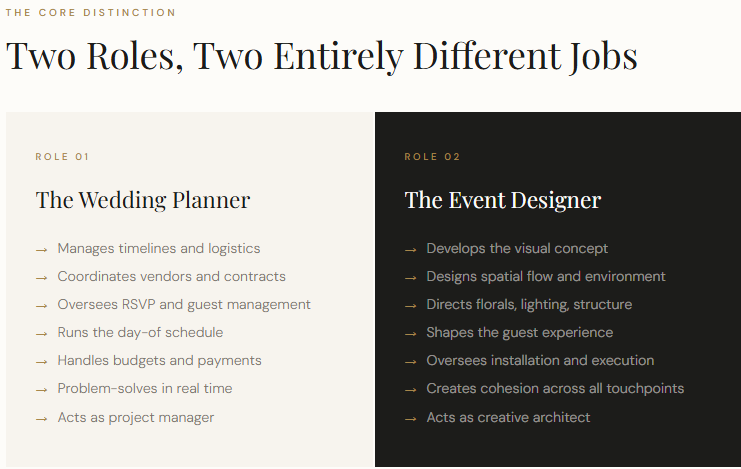
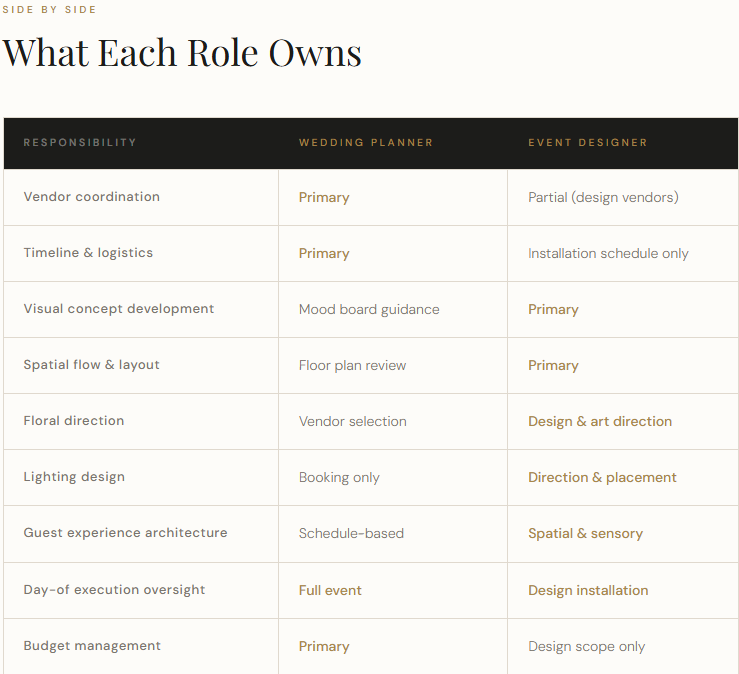
A planner asks: Is everything in place and on time? A designer asks: What does this place make people feel? Both questions matter. They require different skills, different training, and different ways of seeing a room.
Real Example — Toronto Ballroom Wedding
A planner confirmed the caterer arrived at 3pm, the florist at 2pm, and the officiant at 4:30pm. The designer determined that the ceremony faced the wrong wall for the existing chandelier light, repositioned the arch, specified directional uplighting to anchor the aisle, and adjusted table spacing so guests moved naturally from cocktail hour into the reception without bottlenecking at the entrance.
One role kept the event running. The other made it worth attending.
The Third Role
What an Event Architect Does Differently
In Toronto's event industry, a growing number of design professionals operate beyond the decorator-or-planner binary. An event architect approaches the event as a built environment, considering not just how it looks, but how people move through it, what they notice first, where they linger, and what they carry with them afterward.
This is the discipline behind exceptional corporate event design in the GTA and high-investment weddings in Ontario. It starts before florals are chosen or linens are sourced. It begins with questions most decorators never ask:
01 What is the arrival experience?
The moment a guest walks in sets the emotional register for everything that follows. Where does their eye land first? What does the transition from exterior to interior communicate about what's ahead?
02 How does the room direct movement?
Guests should never wonder where to go. Thoughtful spatial design uses visual anchors, furniture placement, and lighting to guide flow without a single sign or instruction.
03 Where are the focal points and do they earn attention?
A room can only hold three to four genuine focal points before everything competes and nothing lands. A designer decides what those are. A decorator often adds without subtracting.
04 What is the sensory sequence?
Sound, scent, light temperature, and tactile texture all register before conscious aesthetic judgment. The best event designers in Toronto work across all of these — not just the visual.
05 What will guests remember?
Not photograph — remember. The feeling of a space persists long after the images fade. This is the question that separates architectural thinking from surface styling.
Beyond Weddings
Why This Distinction Matters for Corporate Events in the GTA
The wedding planner vs. designer conversation applies just as directly to corporate event design in the GTA. Organizations investing in product launches, galas, client dinners, and brand experiences often hire logistics coordinators and assume the design will follow. It doesn't.
A corporate event without a design framework is a catered meeting in a well-organized room. It communicates nothing distinctive about the brand. Guests arrive, they sit, they leave and nothing about the physical environment reinforced the message the business was trying to send.
Real Example — GTA Corporate Gala
A financial services firm hired an event coordinator for their annual client gala at a Vaughan venue. The event ran precisely on time. The room had standard hotel banquet rounds, white linen, and centerpieces from a catalog. Three weeks later, the client's feedback was that the evening felt "like every other gala." The following year, an event designer was engaged. The room was restructured, the brand color palette was translated into light and material, custom table settings were fabricated, and the keynote stage was redesigned as a focal environment rather than a podium on carpet. The event ran the same schedule. The room communicated an entirely different organization.
For GTA companies investing in client relationships, team culture, or brand positioning through live events, design is not the finishing layer. It is the argument.
The Decision
Who Do You Actually Need to Hire?
Hire a wedding planner if:
You have a clear visual direction already in place, strong vendor relationships, and primarily need someone to manage the logistics, timeline, and day-of execution. A planner is indispensable for complex multi-vendor events regardless of design scope.
Hire an event designer if:
You want the environment of your wedding or event to communicate something specific a mood, a personality, a story. If you care deeply about what the room feels like and not just what it looks like in photos, you need a designer, not a stylist or decorator.
Hire both if:
You are planning a wedding of 120+ guests in Toronto or the GTA with a meaningful design investment. The two roles are complementary, not redundant. The best events in Ontario are ones where a skilled planner and a skilled designer respect each other's lane and collaborate without overlap or friction.
Hire an event architect if:
You want the design built from first principles where the concept, spatial structure, material palette, and guest experience are developed as a unified system rather than assembled from separate vendor contributions. This is the approach that produces events that feel singular rather than well-executed.
Alexandria Design House
We Begin Where Most Designers Stop
Alexandria Design House is a Toronto-based event design and spatial architecture practice. We work with high standard couples, corporations, and private clients across the GTA, Vaughan, and Ontario who want more than a styled room they want an environment that holds, moves, and endures in memory.
The House begins with The Spatial Method™ · Foundation First · Proprietary to Alexandria Design House · Toronto · Vaughan · GTA · Montreal Before a single floral stem is chosen or a linen swatch is pulled, the first question asked is How do you want your event to feel? Clarity. Spatial architecture. Experience. The aesthetic naturally follows.
We do not separate planning from design. We do not add decoration to a room that was not built to receive it. Every engagement begins with a full design discovery because the difference between a beautiful wedding and an unforgettable one is always structural.
If you are planning a wedding or event in Toronto, Vaughan, or anywhere in Ontario and want to understand what a foundation-first design approach would mean for your event The House would like to hear from you.
Alexandria Design House · Spatial Event Architecture · Toronto · Vaughan · GTA · Montreal
The Spatial Method™ · La structure avant tout.